|
 |
|
|
||
|
In the fall of 2002 as we were heading back to Spain for our winter hibernation, we came through the area of Lozere and found it to be quite enjoyable. We stayed a couple of days in Mende, a bit off the beaten tourist track. The city itself is quite old, the most ancient structures dating from the 1200’s. The city was a walled city with a moat for protection. While much of the old city remains, the moat has been drained and made into a circular road around the old town. Below the city a 13th century bridge crosses the Lot river (above).
There was a spring at the upper end of the town which fed a fountain for fresh water usage from the 15th century. The streets were constructed so there was constant water flow from the fountain throughout the town, thereby flushing the sewage to the river below (you definitely didn’t want to live down river from the town!).
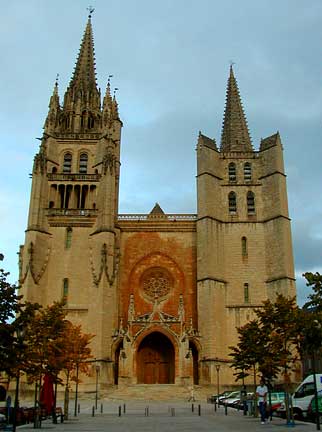
The cathedral (left) was started in 1368 and its spires were completed in 1512. Partly destroyed by the Protestants during the religious wars, it was rebuilt from 1599 to 1620. Notice that the spires do not match - we thought that to be a bit unusual (although no information was given as to why they were different). The smaller one on the right was used as a prison during the Napoleonic wars. During our wanderings through town we found many knives and corkscrews from Laguiole in the shops. We had heard of these before (from Peter Mayle’s book about the better things in life where he suggested that the best corkscrews in the world were made in Laguiole). Since then we have been looking for this place to see what it was about. In asking one of the shop owners, we found that Laguiole was only about 70 km from here - so let’s go! The next day we headed off and found the quiet little town with many shops and a couple factory stores where they make the knives. They all use the same forging process, but individual artisans finish the knives and corkscrews with their own touches. The h The day we left Mende, we headed south to drive through the Gorges du Tarn, where the local road (D907) follows the Tarn river for some 30 kilometers. It was a gorgeous day weather-wise and the ride was very special. Shortly after leaving Mende, we came upon the city of Ste. Enimie, nestled down in the gorge (above). This is definitely some rugged country and must have taken days to reach before the car and nicely paved roads.
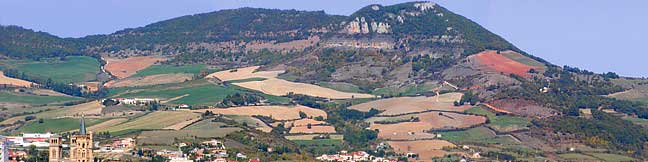
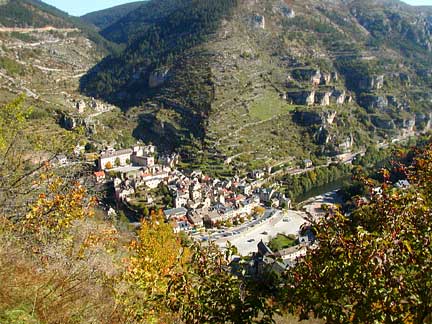
This was a very enjoyable ride, made partly so by the wonderful weather. We highly recommend this drive if you are in the area and have a nice day to enjoy it. Coming out of the Gorges du Tarn we found ourselves in Millau where we stopped on the outskirts of town for a quick bite at one of the roadside Friteries. Although not gourmet food, these stands tend to offer good food at a reasonable price. While enjoying our steak, quiche and frites, we also enjoyed the fine view of the hillsides above the town of Millau (below). This was early October and many of the crops had already been harvested, although some fields were still green with crops. The limestone hills above are quite representative of this area.
 the wheels and aging them in the naturally cool caves. Of course, afterward we did get a taste of the yummy stuff as well. Only the cheese made up on this narrow ridge (an area of 2 km by 30 meters) is allowed to be called Roquefort, which is why it so special. Protection of the process and name was given as early as 1411 by Charles VI. the wheels and aging them in the naturally cool caves. Of course, afterward we did get a taste of the yummy stuff as well. Only the cheese made up on this narrow ridge (an area of 2 km by 30 meters) is allowed to be called Roquefort, which is why it so special. Protection of the process and name was given as early as 1411 by Charles VI.
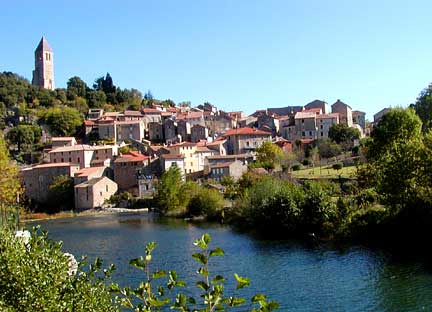
Further south, nearing Beziers, we happened upon this picturesque little village nestled on the hillside above the river (right). As we stopped for a picture, a local gentleman tried in vain to explain something of interest about this town, but unfortunately our French skills just aren’t up to it. Too bad, it could have been interesting and educational. But it was a pretty site anyway so we enjoyed our rest then moved along, no wiser than we arrived. We think the town name may be Olargues. |
|||||
 |
|||||
|
If you find typographical errors or have any other problems when looking at the site please contact the Webmaster describing the problem and the page involved. |
|||||
|
Copyright © 2000-2009 Jim Seavey and Verna Norris All Rights Reserved |
|||||
 South Central France is our definition of the area to the west of Provence and to the east of the Spanish border. It includes the Mediterranean coast, and the many mountain ranges providing fantastic views and even better roads. For the years that we wintered in Spain, Southern France was our doorway to the rest of Europe, so we traveled through it quite frequently. Many times, we simply rode through, intent on reaching our ultimate destination. However, several times we slowed down enough to stop and enjoy all that it has to offer. We were richly rewarded by our decision.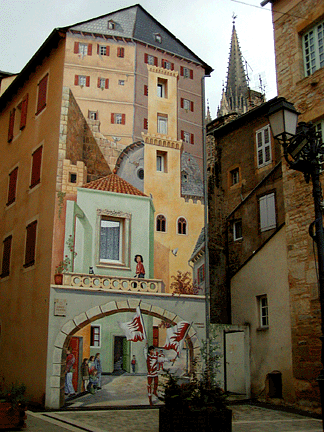
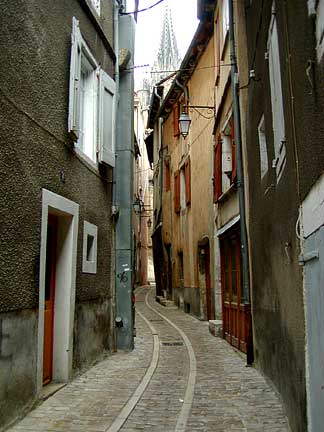
 There are quite a few buildings from the 17th and 18th centuries still standing, but many have been replaced by newer construction. The painting on the building above, right is quite lifelike, incorporating several real windows into the design.
 andles are made from all kinds of wood as well as bone, ivory, and semiprecious stone. There is quite a selection and they don’t come cheaply, but the quality does appear to be excellent. So yes, we had to get one. And it does work superbly.
 Some areas of the gorge are narrow and rocky, while others are wide and green. At left Jim is riding along a quite serious overhang. We’re not sure it would be a good idea to bring the motor home here!