 |
 |
|
|
|
Olives are a major crop in Spain and the production of olive oil is big business. Spain does export some of its olive oil, but most of it is used for domestic purposes. Andalucia is the prime location for growing olives, but you will find olive orchards almost everywhere in Spain (well, at least where it doesn’t freeze in the winter). So in January, 2003, we headed out to the heart of the olive country with our friends, Bob & Kathy Richards. We headed up to an area north of Malaga and south of Cordoba. In this region, the olive groves stretch for hundreds of miles and just about every possible field and hillside is planted with that noble plant. November and December are the prime months for picking olives, and the oil is pressed from November through January. We went to one specific mill, Nunez del Prado (located in Baena), because they produce an exceptionally fine oil. We went on a Saturday so they weren’t processing, but the young man in the office let us into the shop to have a look around on our own. After seeing all the equipment and figuring it out best we could, we went back to the office to buy a couple of bottles of the oil. There we found the owner who told us a bit about the oil, then proceeded to take us on a personalized tour, explaining everything we wanted to know.
After obtaining the “flower,” the paste is then layered onto screens for pressing. Ten kilos of olive paste is placed on each screen, then another screen is placed on top with another 10 kilos. These screens are built up to about 8 feet high on the verticle press, then the top weight is lowered onto the pile and the pressing begins. This process wil use about 5 kilos to make one liter of oil. At right is a photo of the press. The screen seen stacked on the center post are similar to plastic baskets and are easy to clean. Traditionally, woven reed material would have been used. The oil now pours from the press into separating troughs where the liquid is allowed to sit while the oil floats to the top and is siphoned off. The remaining water is discarded and represents about 10% of the total liquid form the press. From here, the oil is pumped into storage tanks. Today large buried tanks are used, though traditionally enamled pottery pots were employed. The family still has the pots that were used in The owner told us that originally his family was from the Rioja region where they grew grapes and made wine. In the late 1700s they moved to this area and started growing and pressing olives (they still grow some grapes and make wine, but only for their own use). They built this processing plant well outside the town of Baena, but since then the town has grown up around them, so they are now in the center of the newer part of town. After processing, the oil is bottled right on the premises. The owner took us into the bottling room where he showed us how they keep track of the oil. Each bottle of the “flower” oil has a number on it. This number is tracked to the date and time it was bottled, which storage tank it came from, and which orchard produced the olives. All done by hand! Below, right is the owner explaining all this to Kathy and Bob. Behind all of this, there is a separate processing plant where they press the oil from the ripe olives. According to the owner, it is edible but he certainly wouldn’t eat it!
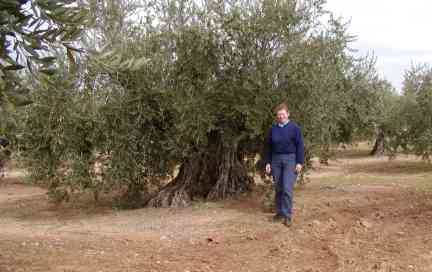
After this great tour, we headed out to visit some of the nearby villages and of course found many orchards of olives while we drove. We stopped for a picture at this one as it was one of the largest trunks we had seen. We had learned that an alive tree becomes mature at about 10-12 years and can produce for another 190 years, although the prime years are from about 10 to 100. After 100 years the harvest quantity decreases, but the quality does not. We have no idea how old this one was, but it certainly was a grand old one.
|
|||
 |
|||
|
If you find typographical errors or have any other problems when looking at the site please contact the Webmaster describing the problem and the page involved. |
|||
|
Copyright © 2000-2009 Jim Seavey and Verna Norris All Rights Reserved |
|||

 T h e ol iv e s a r e pi c k e d (green) from their own orchards where they use only organic growing methods. They are brought in and dumped into large bins where an auger lifts them into the grinding stones (pictured above). These rolling stones crush the olives into a paste which is then fed into long tubes of fine screen (left) where the oil is allowed to drip out, using the force of gravity alone (no pressing is done). This produces what is called the “flower of the oil” and is the finest olive oil available. According to the owner, only their family and one family in Italy
  use this process. It will take 12 kilos of olives to make 1 liter of this oil.
 the late 1700s. The jugs are buried in the ground so you are only seeing about top 1/3 of each one.
 We also learned from the owner that he has just finalized a deal with Whole Foods in the US to sell his “flower” oil. So those of you in the US can now buy this lovely oil. While we were there, we bought a porcelain bottle of the oil for our own use (the porcelain bottle is only available in Spain, so if you want one of those, you have to come here).
 A s w e w er e d ri vi n g h ome, we realized we never asked what the expected harvest per tree was annually. So at one of the many olive processing points, we stopped so Bob could ask the workers about the yield. According to the young man, each tree produces between 100 and 150 kilos of olives a year.