 |
 |
|
|
Porto is a 3 hour train ride from Lisbon on the fast train, occasionally reaching the limit of 230 kph. The train is new and comfortable an is a great way to see the countryside at leisure (or take a nice nap, if you prefer). Porto is a lovely town covering the hill down to the river. But, we arrived in Porto amid rain (it was March, 2001) and the sad fact that major infrastructure renovation was taking place on the streets surrounding our hotel. The cab dropped us at the last unmuddy spot and we trooped through wet sand and dirt, in the rain, schlepping our bags through the slush and construction noise and confusion. The construction company had not fathomed a need for at least a makeshift walkway through the work zone, nor were the focused workmen at all concerned with the crowds of pedestrians edging by open holes, operating jackhammers, or front loaders backing up into the stream of walkers. OSHA would have a field day here.
We opted to arrange a car tour of Porto, and our driver/guide picked us up at the hotel the next morning and gave us a wonderful, four-hour overview of the city, including a bit of Port tasting at one of the lodges across the river. Our guide told us that Porto was a town of industry, the most prominent of which were Port, textiles, leather, and shoes. Porto was established in 4000 to 3000 BC by the Romans. Porto is the “Portu” in Portugal. During the Roman period, a settlement called Cale developed at the river’s mouth. Portus-Cale eventually became Portucalia, and then Portugal.
One of the walls, called the 17th Century Wall, is covered in 800 kilos of silver, all brought from the new world. As Napoleon’s army was marching toward Portugal, the wall was covered with plaster so that the French would not carry off that fortune. The church’s main alter was rebuilt in the 1700’s with gold brought back from Brazil, and it is a dazzling sight. At the second level we entered the chapel and viewed further treasures—church vestments laced with gold thread, heavy with jewels, and books from the 16th century, all perfectly preserved and encased in heavily engraved silver covers. We left the church, running for the car as the rain continued, and headed for one of the five bridges spanning the Douro River. We crossed on the Luis I bridge, also called the Eiffel Bridge (designed by the Frenchman, Eiffel, of the famous tower), sports two levels of traffic, one at river level, and another at the level of the land near the top of the hills on which the towns are built. It was so misty that we could not see any of the other bridges, though the next day we were able to see all of t Then, to the treat we’d been waiting for—tasting the Port. But first, we learned a bit about the history and production of the beverage that made Porto famous. This wine is made exclusively from grapes grown in the Douro Valley, fortified by the addition of grape brandy, and matured in casks or large oak vats. Port was first imported to England in 1667, when France cut off the import of English cloth to France, and England then retaliated by cutting of the import of French wine. The English looked to Portugal, which began exporting its red wine across the Channel. Demand for the Portuguese wine grew, and gallons of Douro Red, t At right is a photo of how they used to do the crushing. And yes, they really did do it by stomping as it was the only way to crush the grapes without crushing the seeds as well. Now however, the machinery has improved and all the stompers are now out of business.
There are several types of port: 1) Vintage, which is a single wine port from a single year, 2) Tawny, which is a blended port made of red grapes and aged for 5 or more years, 3) Ruby, a younger port with older wines added for depth of flavor, 4) White Port, made from white grapes Actually, not every year can produce a vintage wine. A Vintage year is determined by the Companhia Velha, and is usually one in which there is heavy rain and cold during the winter, followed by a warm summer. On display in glass cases at the Graham winery was a bottle for each year since 1870, including the vintage years. The 1977 year was the best vintage year of the 20th century. For those years not designated as vintage, the wine is designated as LBV (late bottled vintage). The LBV wines are matured four to six years in casks of French Oak, then the fermentation is stopped by filtering the wine, and it is bottled. These ports when opened can be drunk immediately as long as the bottle is consumed within a six-month period. The Vintage port is bottled within two years, and left to mature in the bottle for at least 15 years. When opened, it needs to be drunk within two to three days. The Tawny Ports are blended port, where different years or harvests are blended together, all of them being old, however. They are named Tawny after the color they achieve from aging in wooden oak casks for many years, then bottled. Like the Vintage year Ports, the older these are when opened, the better. Raising the grapes used for Port wines is a bit different than the vineyards we are used to seeing in the Napa Valley. In the Douro Valley, “sheer rock faces and harrowing ravines are interspersed with rocks and seemingly inhospitable schistous soil,” according to Graham’s description. Apparently, these grape vines are in their element where nothing else will grow, pushing their roots deep into the schist. In the pictures of the vineyards, it appears that the vines are growing on steep slopes of rock.
As we returned to the hotel the sky cleared a bit, and we were able to make a foray into town for some dinner and a bit more sightseeing. The following day we again encountered rain, but determined our way into the shopping areas just to enjoy the sights and the people. We all vowed we must get back to Porto when the weather was warm and sunny. As we traveled back to Lisbon the next day, we finally saw blue sky and a break in the storm. Crossing the river leaving Porto, we were finally able to see the city in its splendor - we’ll be back! In July, 2001, we returned to Porto on a warm but overcast day. As we neared town, the continuing road construction had all but stopped incoming traffic. We were routed on narrow cobbled streets up and down hills, trying our best to keep cool on the bikes. We finally made our way through town and as we passed over the bridge to Vila Gaia, got a great view of Porto in the sunshine, something we missed the last time we were here. But, by the time we had unloaded the bikes and got into our room, it was pouring rain and the river was not to be seen for the low-lying clouds. Seems that it rains every time we come to Porto! We walked to Porto from Vila Gaia, over the top level of the Eiffel Bridge, then up through many narrow, windy streets with little hole-in-the-wall shops selling anything these entrepreneurs were able to get their hands on to sell. These were streets where the neither the street nor the buildings had the benefit of modernization and remained much as they had been for many years. It was a reminder of how poor the country had been until the recent reforms in conjunction with EU membership. While much-needed funds have been pouring into this country for years, it is obvious that the many more years of neglect have taken their toll. Things are improving, but there is still a long way to go to bring Porto (as well as many other areas of Portugal) up to the level of other European countries.
|
||
 |
||
|
If you find typographical errors or have any other problems when looking at the site please contact the Webmaster describing the problem and the page involved. |
||
|
Copyright © 2000-2009 Jim Seavey and Verna Norris All Rights Reserved |
||
 Our hotel receptionist suggested a local restaurant for lunch, and he was right on the money. The Restaurant Abadia was just a couple of blocks away and caters to the local business folk. We had a little trouble with the menu, but managed to order 4 big, delicious meals. An appetizer was brought first which we have no idea what it is called, but it was delicious. We think it is shredded cod, deep fried in balls. We were close to a pedestrianized street, so spent the afternoon and evening wandering along with the locals, dodging raindrops (not very successfully). The next morning we opted out of the hotel breakfast which didn’t sound too appetizing, and decided to try the Majestic cafe (pictured at left are Jim, Gene and Joan - we were the only ones in the cafe) which we had found the previous evening in our wanderings. It was a great choice! The food was plentiful and good, and the atmosphere was delightful.
 We moved to a more comfortable and less lively hotel the next morning, and then ventured out to explore Porto, the second-largest city in Portugal. Porto is in the Douro province, and on the Douro River as it reaches the Atlantic Ocean. Upstream from Porto is the Douro Valley, famous for growing the grapes used in making Port wine. The city is built on steep granite hills above the river, which has five bridges connecting the city with the “other half,” the Vila Nova de Gaia, the historic home of the port-wine lodges, which are Porto’s biggest tourist draw.
 We stopped at the Sao Bento train station (it was not the one we came into from Lisbon), and walked around marveling at the beauty of the walls (left). The station was originally a monastery, and the high walls are covered from bottom to top in murals done in blue and white tiles (azulejos) depicting historical events of Portugal, as well as everyday life through the centuries. Battles showing Celts, Romans, Arabs, and Christians abounded, along with scenes of the French and Spanish kings of Portugal. At the ceiling were the words, Minho and Douro, which our guide explained were two of the eleven provinces of Portugal, and, in his opinion, by far the two most beautiful ones. Prominent among the murals was one of Henry the Navigator, who was born in Porto, and is buried there.
  After a ride through some of the town, we stopped at the Cathedral, which marked the beginning of the current city, in 1120, following the removal of the Moors. The cathedral was at the top of a hill overlooking the Douro River, but with the rain and the fog, we could not even see the river, much less across it. We scurried into the church to get out of the weather. The cathedral has undergone many renovations during the centuries, and the Baroque period was the most important one contributing to its current state. It was a wonder of gold and silver. At the right is one of the smaller shrines in the cathedral.
 hem.
hem. o which a bit of brandy was added with the hope that it would travel better, was shipped to England. The addition of brandy arrests the fermentation of the wine, while retaining its sweetness and raising the alcohol level.
 By 1756, the Marques de Pombal founded a state monopoly, the Companhia Velha, or “Old Company” to control port wine standards and prices. It specifies that only port from a specific region in the Douro Valley—the world’s first demarcated wine region—can be exported. The photo at left shows this region being due east from Porto, just west of the Spanish border (see our page on the
 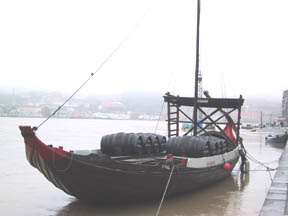 We continued our car tour through the old and new parts of Porto, peering at the sights through the mist and fog that made us wonder if we’d suddenly been transported back into San Francisco—or the tulles of the Sacramento valley. At left is a picture of the old boats they used to use to bring the new wine from the Douro valley down to Porto to be aged. They are no longer used today as there are now several dams along the river.
  Finally, on the morning we left, the sun broke through to dazzling blue skies and we were able to see colorful Porto in all its glory. At right is a picture looking across the river Douro to the city of Porto, its colorful buildings clinging to the hillsides. In the foreground are the boats once used to haul the wine to Porto in the spring (now trucks with stainless steel tanks are used).
 At left is a close-up of the colorful houses near the river in the Ribeira district. Many have laundry hanging outside the window to dry. The river is much lower now than in March when we first came. It is now about 8’ below the wall whereas in March it was almost even with the top of the wall. When we were taking the port tours, we saw many small signs on the walls indicating the flood level at various years. In 1966 the mark was about 3’ high on the wall in the building which sat another several feet above the river wall. In the early 30’s there was a mark on the wall over 6’ (it was above Jim’s head). Now that’s a lot of water when you consider the width of the valley at this point! However, we were assured that the port was well sealed in their casks and suffered no harm.