|
Venice is a city of 116 islands connected by 409 bridges. Armed with this information it is easy to understand why moving about town on the water is the sensible way to travel. Well, that or on foot. Vehicles are not allowed in the city and if you choose to bring in a car you must leave it in one of three parking lots where the charge is ~18.00 Euro for 24 hours OR portion thereof.
|
We arrived the last day in April, 2002 and found a hotel about a half hour bus ride out of town and took a room and parked the bikes. It’s the bus and foot travel for us for the next two days.
After a short bus ride, we arrived at Piazza Roma, the main entry point in Venice, where all the cars park and the busses arrive and depart. From here, we grabbed a vaporetto (water bus, in the picture at right) to take us closer to St. Mark’s Square, probably the most visited area in Venice. You can ride all the way to the square, but we decided to stop midway and explore some of the back alleys on foot.
|
|
|
|
|
Make sure you have a good map before you strike out on foot, because nothing is straightforward. There are numerous dead-ends and bridges that simply lead into shops, so even with a detailed map, it can get confusing. However, not deterred, we made it to St. Mark’s (along with several hundred others) to view the majestic cathedral (left). There was quite a long line to enter, so we passed on that one. There is also a bell tower 99 meters tall that you can climb for a panoramic view of the city. That line was also very long (and costs 5.50 Euro for the privilege), so we passed on that was well. We did, however, window shop all along the square, knowing that the prices here were much higher than elsewhere in the city.
|
|
|
|
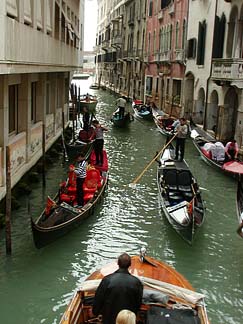
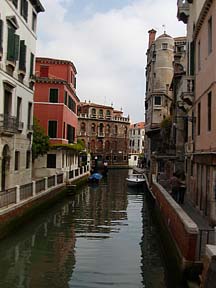
We continued our sojourn through the streets, determined to avoid the worst of the tourists. Sometimes we succeeded. We found some lovely, peaceful street and canals (such as the one at right) and enjoyed the sights and sounds. Of course, not all the waterways were this peaceful and some of them became near traffic jams, like the one at the left. There appeared to be few rules of the road and they seemed to go where they wanted. However, it also appeared that the powerboat (approaching from the bottom of the picture) had (or was taking) the right-of-way. For the most part, it seemed that the gondolas got out of everyone else’s way. Perhaps it is just a game of intimidation as it is on the highways.
|
|
|
|
We had been forewarned that the cost of food here was outrageous so we were happy when we found a quiet Chinese place for lunch that served us with tasty, fresh food for a reasonable amount. Now, you would think that Chinese isn’t the best choice in Venice, but we ate well for about half of what we would have paid in a regular restaurant. The only other choice is to grab a panini or sandwich from one of the many cafes and eat it at the bar (it costs more to sit and eat) or eat as you stroll. All in all, we think we made a good choice. Of course we also had to sample the gelato (a bit overpriced, but good) and a pastry or two. Then we had to walk another couple of hours to work it all off.
|
|
|
|
|
We used a combination of walking and water bus to make our way to one of the more famous bridges, Rialto (right). This bridge is lined with shops and even more crowded with tourists. It is fun to check out all the goods available, but necessary to shop well. We found the same T-shirt increasingly cheaper as we walked away from the bridge. We also spent quite a bit of time investigating the variety of Venetian glass available. There is everything from cheap baubles for a couple of Euro to works of art for several thousand. Verna was particularly taken by the vases and plates with lifelike fish and other sea life floating in the glass. But alas, another day empty-handed. Another of the items found everywhere are the masks used during Carnival (above). There is quite a variety available, from pretty to grotesque.
|
|
|
There still are gondola-building enterprises in Venice, and we found one with a couple of in-progress gondolas out front (above). When you see them straight-on, it is quite obvious that they are not symmetrical. The center of the boat is slightly to the left (as you are facing the boat) because the gondolier stands on the right with the oar on the left (when looking at the boat from the front). If they were built symmetrically, they would probably crab their way down the canals and be very difficult to maneuver. However, even with the special design, it is apparent there is an art to maneuvering one of these, and it probably takes many years to master (which could be why they are so expensive to rent).
|
|
|
|
|
Although the waterways are the major feature of Venice, there are thousands of streets and alleys, many as narrow as this one in the picture to the right. When you have a limited amount of space on which to build, we suppose that you don’t waste much of it on pavement. These narrow alleyways appeared to be norm in the more residential neighborhood, while the wider walkways were reserved for the areas with shops and restaurants. We were watching a young lad kicking his soccer ball down one of these alleys and wondered if children here ever got to play on grass or dirt, since every bit of land we had seen was either paved or built upon. Just before we left the city, we found a public garden, complete with old shade trees, dirt paths, and play apparatus. It was really pleasant to wander through this green area with birds singing after wandering along pavement all day.
Of course, just to prove we’ve been here, a shot of Verna on the Academia Bridge.
|
|
|





