 |
 |
|
|
we arrived at the Bordeaux in June, 2001. Bordeaux is fairly large, with a population of over half a million. There are coach tours to the wineries which can be scheduled on Wednesdays and Saturdays. And, we found that there was a walking tour every day, except Wednesdays and Saturdays. The walking guides give their spiel in French, then in English. If you did not understand either, you’re out of luck.
At the city end of the square is the Monument aux Girondins, a glorious ensemble of statues and fountains built in honor of the influential local deputies to the 1789 Revolutionary Assembly. During W.W.II, the occupying Germans planned to transport the massive work of art to Germany to melt it down for munitions. The French Resistance made sure it never got to Germany - the train was waylaid and s In Roman times, Bordeaux was the capital of the province, Aquitania Secunda, and a marriage between Eleanor of Aquitaine and King Henry II of England, in 1152, made the province a principal English foothold. It was to that presence, and particularly the English’s taste for the region’s red wines, which they call Claret, that the Bordeaux region experienced its first economic boom. The second occurred with the expansion of colonial trade in the eighteenth century. The trade, sadly, was in slavery. In 1716, the French king authorized the city to engage in slave trade, sending ships up river to the Atlantic, then down the coast to Africa to load slaves for transport to the New World. In exchange, they returned to France with cargoes of tobacco, chocolate, coffee, sugar, and precious woods.
Just an aside on the parking habits in both Spain and France. No room to park on the street? Not a problem. Just park on the sidewalk. One has to walk out into the streets to get around cars parked on the sidewalk. Between the cars and the dog doo, one keeps a watchful eye on where one is going! On Sundays, Bordeaux closes off all streets leading to the center of town. For block after block, the streets is are open only to walkers, bicyclers, and skaters. The whole city turns out for this wonderful event.
Since 900 AD, Bordeaux was ruled by dukes, who were more like kings in their ownership of all the land and the people. Through several centuries, the Dukes of Bordeaux ruled, but in the early 1100’s, no male heirs appeared. Thus, the last Duke’s daughter, Eleanor of Aquitaine, became Duchess. She married the King of France, but after 15 years of marriage they had only two daughters. Morose at having no male heirs, the King got the Pope to dissolve the marriage. Eleanor took back her duchy, and subsequently married the King of England, as mentioned earlier. Thus, the English held the Bordeaux region for two centuries. At the end of the 100 Year War, in the latter part of the 1500’s, France won back Bordeaux. England had been very good to Bordeaux, and, besides being its best customer for their red wines, the Kings had purposely kept taxes low to encourage brisk trade across the channel. To punish the inhabitants for their long allegiance to England, the French King levied high taxes on them, stopped all trade to England, and took away the city’s right to rule itself. The rebellion that this fomented caused the French King to build the military fortress that stood in the Esplanade des Quinconces mentioned above. On Saturday’s the immense outdoor farmers market is in operation, which runs for blocks and blocks. Sunday morning, the vendors are there again, offering beautiful cheeses, an unlimited variety of sausages, the Basque jamons, all varieties and colors of fresh vegetables and fruits, and an amazing array of flowers, plants, and trees. One small park was set up to display cage after cage of every type of colorful songbirds, and such treats as beautifully feathered wood ducks, and even graceful swans. To stroll along street after street, looking at the wares and not seeing a car for miles is a great treat. A few items learned about the great Bordeaux wines:
We drove through miles of wine country, sighting chateaux sparsely scattered amid miles of vineyards. The production of grapes and the making of wine in France is not much different from the Napa Valley, California wineries. But, don’t tell the French that! One exception was the making of Sauternes, which is one of the touted wines of the Bordeaux region. There is a great deal of humidity in the fall in the Sauterne region of Le Vignoble de Bordeaux, because of the meeting of the River Garonne and the River Ciron. Each river is a different temperature, and the humidity that meeting of waters in the warm sun causes the grapes to partially rot, concentrating the sugar. Called “The Noble Rot,” this process creates the distinctive taste of the Sauternes. The condition of these grapes means they must be picked by hand, and it require five or six pickings as the grapes must be at a perfect stage in “The Noble Rot” when harvested. This is what makes the good Sauternes so expensive. A brief review of the aging process of the red wines, and the resulting taste:
Being on the bikes we have not engaged in any wine tasting - sigh. |
||
 |
||
|
If you find typographical errors or have any other problems when looking at the site please contact the Webmaster describing the problem and the page involved. |
||
|
Copyright © 2000-2009 Jim Seavey and Verna Norris All Rights Reserved |
||
 The Esplanade des Quinconces is next to the Tourist Office. At one time, the space was a military installation that was later destroyed in the French Revolution. It’s been left open ever since, and used for parking, for circuses and other celebrations.
 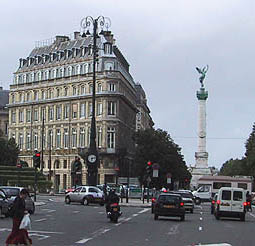 ent west to Nantes. There undercover of darkness, the artwork was dismantled, piece by piece, and hidden. After the war, it was returned to Bordeaux, but unfortunately, it was then stored and forgotten! The ensemble was rediscovered about 13 years ago, and installed at the square. It is quite a magnificent piece of sculpture. The picture above is the fountain portion at the base. At right you can see the tower of the sculpture as viewed from the Place de la Comedie with the Maison du Vin at the left.
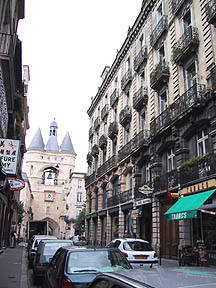 The narrow streets of the south end of old town are lined with typical grand mansions from Bordeaux’s glory days. The social hub of the eighteenth century, the Bordelais mansions, is peppered with wrought iron balconies. Set on wide streets with a graceful tree-lined median, these homes were built by wealthy merchants who wished to escape the narrow streets of the town, and to ride up and down in their carriages and seen by other wealthy merchants! Sounds similar to the tea rooms we have seen in the Netherlands from the same period. Originally, these homes were limited to three stories, since they were in a direct line from the military square mentioned above. The military was in full force in the 1600’s, and when canon shots thundered out in the city’s defense, they needed to clear the house rooftops. When the military base was dismantled, many of the homeowners added more floors to their abodes. Thus, only two houses are left in their original size. At left is a view of the Rue de Mirail looking toward the Grosse Cloche (Big Bell).
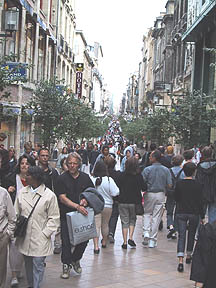 Fortunately, there were no air strikes on Bordeaux during W.W.II, so all the architecture has remained intact. However, the years have taken their toll on many of the buildings. Buildings are continually renovated to stave off the affects of age; if rebuilding is required, they are rebuilt in exactly the same size, shape, and style as the original building. Thus, old town has remained much as it appeared several centuries ago. This includes the narrow, winding streets, many of which are restricted to pedestrian traffic. At right is the Rue Ste. Catherine, the main pedestrianized shopping street, full of shoppers. This street is more than 1.5 miles long and was full of shoppers the entire distance!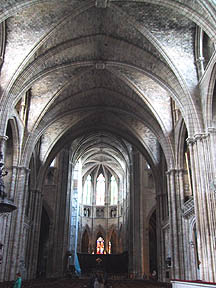
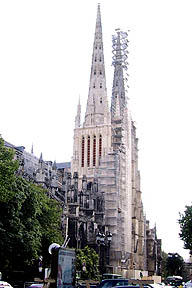 The Church of Notre Dame (how many are there?) is a lovely 1700’s Baroque edifice. Also, St. Peter’s Church, which was the center of the old city is surrounded by all the markets. The most impressive of all is the Cathedral St. Andrews, built in the 13th and 14th centuries. As were most churches of the time, it is a fine example of French Gothic architecture, complete with flying buttresses on the outside and graceful gothic arches in the interior (left). Surprisingly, the interior is adorned with only a few stone sculptures and stained glass windows, providing a sense of elegant simplicity. However, time and pollution have taken their toll on the both the interior and exterior which are currently undergoing renovation and cleaning. The portions that have been restored are beautifully clean while the remainder is almost black with dirt and soot. Above right the two towers at the entrance are partially covered with scaffolding.
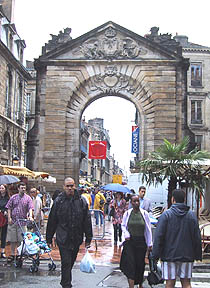 Porte Dijeaux, the old city gate (left), where you can ascend many narrow, winding steps to reach to top. In the former dwelling area, you can see the opening where the gate was lowered to close the city in times of invasion. Also, the large opening in the floor, from which the hot oil could be poured on the invaders.