|
Copenhagen, founded in the 12th century, is the capitol of Denmark and is home to 1/3 of the country’s 5 million people. Copenhagen translates to “Merchant’s Harbor” and it remains a thriving harbor today as well as the cultural center of Denmark. The center of the city is a lively, bustling place and has more bicycles than cars traveling the streets. With the high cost of cars and lack of parking in the city, only 2 in 10 families in Copenhagen own a car. Everyone has a bicycle and 1/2 of the population use their bicycle everyday. When walking, it is equally important to watch for the bicycles as the cars. All main streets have dedicated bicycle lanes and for the most part the cyclists obey the traffic signals. The city is full of shops, eateries, historic sites, and public squares and gardens. There is plenty to see and do to keep one busy for several days.
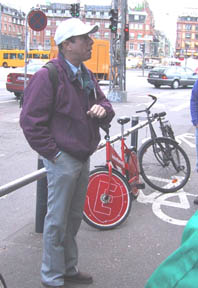 Luckily, when we arrived in June 2001, we found a walking guide at the tourist office and attended several of his walks. Richard Karpen is an American who has lived in Denmark for 15 years and provides daily walks through various parts of the city. We highly recommend his tours, especially since they were the source of most of this material! At right is a picture of Richard explaining the use of the public bicycles (the red one) - for a returnable 20 Kroner, you have use of one of the many bicycles available to the public. Luckily, when we arrived in June 2001, we found a walking guide at the tourist office and attended several of his walks. Richard Karpen is an American who has lived in Denmark for 15 years and provides daily walks through various parts of the city. We highly recommend his tours, especially since they were the source of most of this material! At right is a picture of Richard explaining the use of the public bicycles (the red one) - for a returnable 20 Kroner, you have use of one of the many bicycles available to the public.
 Hans Christian Andersen (statue at left) is one of Denmark’s literary greats and is known worldwide for his fairy tales. He came to Copenhagen by himself at the age of 14. He wanted to be a singer, but his voice changed, so decided to be dancer, but was a bit gangly and awkward, so became a writer. We particularly liked his views of traveling when he said “To travel is to live.” Our sentiments exactly! One of the favorite stories of Andersen’s is of The Little Mermaid and there is a statue of the mermaid in the harbor which was inspired by the story. Hans Christian Andersen (statue at left) is one of Denmark’s literary greats and is known worldwide for his fairy tales. He came to Copenhagen by himself at the age of 14. He wanted to be a singer, but his voice changed, so decided to be dancer, but was a bit gangly and awkward, so became a writer. We particularly liked his views of traveling when he said “To travel is to live.” Our sentiments exactly! One of the favorite stories of Andersen’s is of The Little Mermaid and there is a statue of the mermaid in the harbor which was inspired by the story.
One tour we went on was to the Rosenburg Castle, the king’s “country” residence, outside the city at the time it was built. Now it is within the city and the grounds are an important public park. The castle itself is full of royal relics, furniture, thrones, and of course, the crown jewels.
 One of the more unusual pieces of furniture in the Castle is a chair, which when sat upon, clamped the arms of the unknowing visitor in order to hold them in place while a jet of water squirted up through the seat. After the visitor was released and as they raised up from the seat, a rather obscene sound was made. Sort of an early version of the whoopee cushion. One of the more unusual pieces of furniture in the Castle is a chair, which when sat upon, clamped the arms of the unknowing visitor in order to hold them in place while a jet of water squirted up through the seat. After the visitor was released and as they raised up from the seat, a rather obscene sound was made. Sort of an early version of the whoopee cushion.
Upstairs in the Knight’s Hall sits the 2 thrones and 3 silver lions once used for coronations. But the monarch is no longer crowned. However, when a monarch dies, the lions are set with the coffin, along with the crown.
 Downstairs in the treasury are the crown jewels, a beautiful collection of diamonds, emeralds and pearls, as well as the actual crowns for the queen and king. There is also the crown of Christian IV, which is a gorgeous piece of workmanship, both inside and out. In those days, the detail of the gold work and the number of symbolic figures was much greater. Later Christian IV ran out of money and had to pawn the crown, but it was purchased back before the coronation of his son. Downstairs in the treasury are the crown jewels, a beautiful collection of diamonds, emeralds and pearls, as well as the actual crowns for the queen and king. There is also the crown of Christian IV, which is a gorgeous piece of workmanship, both inside and out. In those days, the detail of the gold work and the number of symbolic figures was much greater. Later Christian IV ran out of money and had to pawn the crown, but it was purchased back before the coronation of his son.
 Lutheranism is the state religion and 87% of the population is Lutheran (although only 2% attend church regularly). A portion of each person’s taxes goes toward supporting the church and the workers employed by the church are civil servants. Although such a great proportion of the population is Lutheran, they are very tolerant of all the other religions. Persons not belonging to the Lutheran church can have their tax kroners directed to the religious order of their choice. While the churches are very grand, they are nothing like the orn Lutheranism is the state religion and 87% of the population is Lutheran (although only 2% attend church regularly). A portion of each person’s taxes goes toward supporting the church and the workers employed by the church are civil servants. Although such a great proportion of the population is Lutheran, they are very tolerant of all the other religions. Persons not belonging to the Lutheran church can have their tax kroners directed to the religious order of their choice. While the churches are very grand, they are nothing like the orn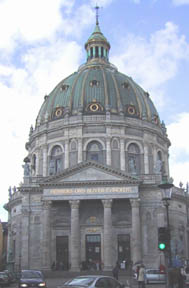 ate Catholic churches we most often see in our travels in Western Europe. The Lutheran motto is “Quiet simplicity and noble grandeur” and is certainly displayed in the Church of our Lady (above, right). ate Catholic churches we most often see in our travels in Western Europe. The Lutheran motto is “Quiet simplicity and noble grandeur” and is certainly displayed in the Church of our Lady (above, right).
The Marble Church (left) is also quite grand, though actually has very little marble in its construction as there wasn’t enough money to purchase all the marble needed. This church took 194 years to complete and has a dome like St. Peter’s in Rome. We were also told that 25% of the ministers are now women and that is expected to increase in the future as there are currently more women studying for the ministry than men.
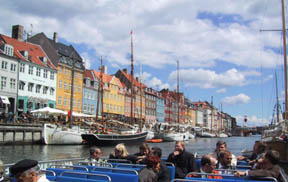 One of the cheerful areas of the city is New Harbor which was built in the 1600s, so it isn’t all that new. It was the original harbor where the sailors would come to drink, get a girl, and spend their money before sailing out again. It was once a high crime area, but today it is full of outdoor cafes and is where you can catch a boat to take a canal cruise (if the weather is nice). There are 2 cruise companies with similar boats that take you for an hour’s cruise around the harbor area. The difference is that one is white and charges 50 Kroner per pe One of the cheerful areas of the city is New Harbor which was built in the 1600s, so it isn’t all that new. It was the original harbor where the sailors would come to drink, get a girl, and spend their money before sailing out again. It was once a high crime area, but today it is full of outdoor cafes and is where you can catch a boat to take a canal cruise (if the weather is nice). There are 2 cruise companies with similar boats that take you for an hour’s cruise around the harbor area. The difference is that one is white and charges 50 Kroner per pe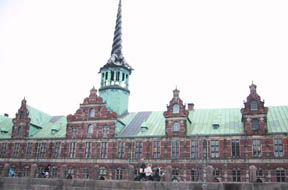 rson and the other one is blue and charges 20 Kroner per person. The white one also has several stops where you can hop off and on. Being the cheap sorts, we took the blue one and had a great cruise! The boats are open-top so it is best to go when it doesn’t look like rain (we only got a few drops). You get some great views of the city and the surrounding islands. At left is a view of the stock exchange from the canal. The unusual spire is 3 dragons’ tails spiraling upward. This is the oldest stock exchange in the world. rson and the other one is blue and charges 20 Kroner per person. The white one also has several stops where you can hop off and on. Being the cheap sorts, we took the blue one and had a great cruise! The boats are open-top so it is best to go when it doesn’t look like rain (we only got a few drops). You get some great views of the city and the surrounding islands. At left is a view of the stock exchange from the canal. The unusual spire is 3 dragons’ tails spiraling upward. This is the oldest stock exchange in the world.
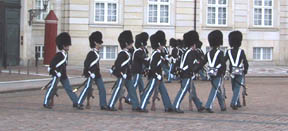 In the Royal Square, the changing of the guard takes place every day at noon (right). The guards in their In the Royal Square, the changing of the guard takes place every day at noon (right). The guards in their  royal uniforms and fuzzy hats march gallantly through the square to relieve the other guards. At one guard post, a single guard stands at attention in front of the small red niche where his rain coat hangs. When the guard is changed, two guards approach and one reaches into the niche to check behind the cape to be sure there isn’t a woman hiding in there (guard duty was a cold and lonely duty in days gone by and a companion often helped to pass the time). The photo at left shows the guard checking the coat. Once assured of no hiding women, the guard is relieved of his duty. Each guard works a 24 hour shift, on guard for 2 hours with a 4 hour’s rest, then back again for another 2 hours. royal uniforms and fuzzy hats march gallantly through the square to relieve the other guards. At one guard post, a single guard stands at attention in front of the small red niche where his rain coat hangs. When the guard is changed, two guards approach and one reaches into the niche to check behind the cape to be sure there isn’t a woman hiding in there (guard duty was a cold and lonely duty in days gone by and a companion often helped to pass the time). The photo at left shows the guard checking the coat. Once assured of no hiding women, the guard is relieved of his duty. Each guard works a 24 hour shift, on guard for 2 hours with a 4 hour’s rest, then back again for another 2 hours.
|


