|
|
We visited Dubrovnik in early June, 2003 and we were immediately struck by its beauty. The town is completely enclosed by perimeter walls built from the 13th to the 16th centuries. Inside, the buildings date from the 14th to the 18th centuries. More than half the wall faces the sea, while the other portion climbs the hillside above. The buildings are all made from the same light colored stone, giving a uniform effect to the city. The public squares are paved with marble, warn smooth and polished over the years. The roofs are covered in clay tile and you can easily tell the new ones by their darker, more uniform color.
|

|
|
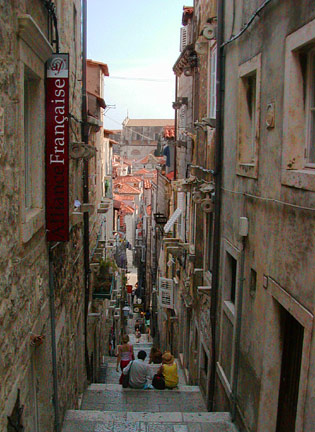
We entered the city from the north, at the highest point and were greeted by the view (below, right) down the long flight of stairs into the city.
Dubrovnik suffered much damage from the fighting in the early 90’s, but most has been repaired or restored. However, walking down the main pedestrian path (above, left), you can still see small holes blasted in the walls and marble as a result of the fighting.
Most of the buildings on the north side of town are residential while the palaces and churches are near the center and southern portions of the town.
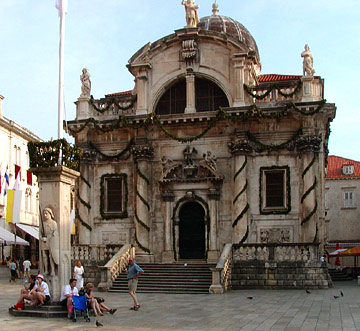
 Dubrovnik features 5 fortresses, 2 palaces, a cathedral, 18 churches, a synagogue, a mosque and several convents and monasteries. One of the churches above (left), St. Blaise’s church (Italian Baroque, completed in 1715), is near the central promenade and was still covered with boughs of laurel from the Pope’s visit just 2 days before we arrived. Jim is trying to walk out of the photo but for once, Verna was too quick for him. Dubrovnik features 5 fortresses, 2 palaces, a cathedral, 18 churches, a synagogue, a mosque and several convents and monasteries. One of the churches above (left), St. Blaise’s church (Italian Baroque, completed in 1715), is near the central promenade and was still covered with boughs of laurel from the Pope’s visit just 2 days before we arrived. Jim is trying to walk out of the photo but for once, Verna was too quick for him.
Dubrovnik was founded 1300 years ago by refugees from Epidaurus in Greece. In medieval times, Dubrovnik was the most important independent city-state on the Adriatic after Venice. It remained an independent republic until the Napoleonic invasion in 1806 when it became part of the Illyrian provinces, later to become Yugoslavia.
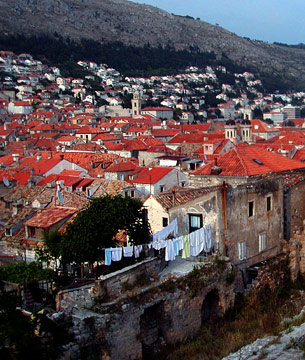
Visitors can walk the entire length of the city’s wall, which we did one very warm evening. We were hoping the setting sun would be cooler, but found the retained heat in the stone walls overpowering. Regardless, it is a great walk (about 2 km) and provided stunning views of the city from every angle. Above, right is a photo showing early ruins in the foreground, the well-preserved old city in the middle, and above, the newer residential area climbing the hillside (where we found a great little studio apartment for our stay). At left the local teens show us how to cool off in the clear waters of the Adriatic.
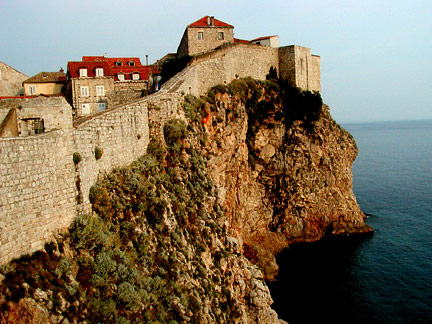
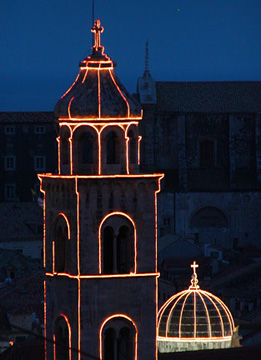
The photo above left shows the wall as it is built right on the top of the sea cliffs. And at night, some of the towers are lighted, providing an interesting view of the city (above right).
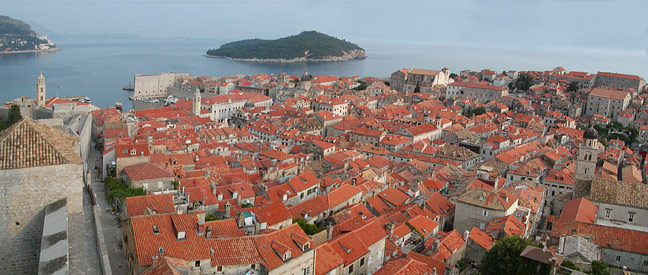
During our walk we were able to capture a panorama of the city and its clay roofs (above). The original roofs were a honey-colored clay (as seen on the roofs at the far left and far right of the photo) and much effort is put into reusing the original tiles when restoration work is being done. Unfortunately, so many were lost during the fighting that the town is now mostly newer tiles. However, it is still a striking view and a treasure that hopefully will last many more centuries. |