 |
 |
|
||||||||||||||||
|
Nearly 50% of the country is forested and another 22% is wetland. To the north is the Gulf of Finland and the Baltic Sea lies to the west. Estonia has numerous lakes, some of which are the largest in the Baltic Countries. Ethnic Estonians make up 68% of the population with Russians making up 26%. In 1934 Estonians comprised more than 91% of the population. Estonia was the first of the Baltic countries to hold elections after breaking free of Soviet dominance in 1992.Our primary stop in Estonia was the capital city, Tallinn, on the north coast. The site is thought to have been first populated by the Finno-Urgic people in 2500 BC, with the first Estonian settlement in the 9th century AD. In 1219 the Dane sconquered Estonia and from then to the 1500s Tallinn was passed back and forth from the Danes to the Germans, later the Swedes, and finally the Russians in 1710. Above is one of the old Gothic houses, now used as a medieval restaurant. Notice the few number of windows on the upper floors. In the days when it was built, people lived only on the ground floor(it was all they could heat) and the upper floors
 The lower town was also fortified and today much of the walls still stand. Below left, four of the original towers along the wall still provide a daunting view. At this end of the city is one of the remaining city gates (right)with Fat Margaret (at left in photo at right), a large round bastion guarding this end of the town. The lower town was also fortified and today much of the walls still stand. Below left, four of the original towers along the wall still provide a daunting view. At this end of the city is one of the remaining city gates (right)with Fat Margaret (at left in photo at right), a large round bastion guarding this end of the town.
Above the lower town stands the Toompea, the legendary burial site of Kalev, the heroic first leader of the Estonians. Here was built the Danish castle in the 1200s (no longer existing) and later the Toompea Castle from the 18th century, now the home of Parliament. Across the courtyard from Parliament stands the 19th century Alexander Nevsky Cathedral (left), built as part of a general wave of Russification in the last quarter of the 19th century. In front of the church 5 local ladies stood, begging for alms as the visitors swept in and out of the church. Each earnestly waited for a handout, and when one came, the others looked on to see what was given and if they perhaps would be lucky as well.
 While wandering through the streets of Tallinn, we saw the bride and groom, below, in their carriage after the wedding, ready to start a new life together. While wandering through the streets of Tallinn, we saw the bride and groom, below, in their carriage after the wedding, ready to start a new life together.
We found in Tallinn many internet cafes, several wireless, and apparently an eagerness to be part of the electronic age. Evidently their next elections will be done by voting online! And this was the first place where we found a guesthouse that had internet access in each room (unfortunately they were booked so we couldn’t get a room).l Jim did spent a bit of time online uploading the site and catching up. Luckily the access was also at a reasonable rate. After Tallinn, we headed back south heading through the east half of the country. We found the countryside to be much more like Finland than the other Baltic states. It is hilly, quite forested and has many lakes.
Our only other stop in Estonia was in the southeastern corner, an area we found to be quite lovely to ride through. This area is more hilly and forested than most of Latvia but very little population. We explored a few of the dirt back roads (in fairly good condition) before we finally settled in the town of Voru for the night. From our lakeside hotel room we had a nice sunset view (right).
|
||||||||||||||||||
 |
||||||||||||||||||
|
If you find typographical errors or have any other problems when looking at the site please contact the Webmaster describing the problem and the page involved. |
||||||||||||||||||
|
Copyright © 2000-2009 Jim Seavey and Verna Norris All Rights Reserved |
||||||||||||||||||
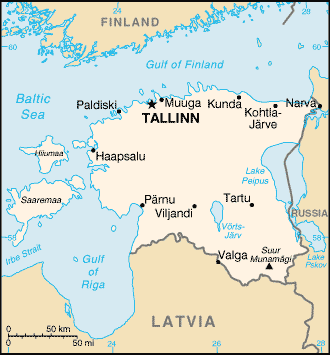 We visited Estonia in August, 2003. Estonia is the smallest Baltic country at 45,227 square kilometers (28,102 square miles). In the east is Russia and Latvia to the south. Tallinn is on the north coast and is the capital of Estonia.


 We stopped midday in Tartu for some lunch and found it to be a quite university town with little touristy stuff, much to our liking. In the center of town stood the town hall (left), looking bright and clean after the passing rain storm. We found a small outdoor cafe in the quiet square where we enjoyed our tasty meals. This is also where we met Francesco and Simonetta, an Italian couple that rode into town about the same time we did and ate at the same restaurant. We enjoyed swapping stories, then continued to meet them at several other points for the next two days as we traveled on through Estonia, Latvia, Lithuania and into Poland.