|
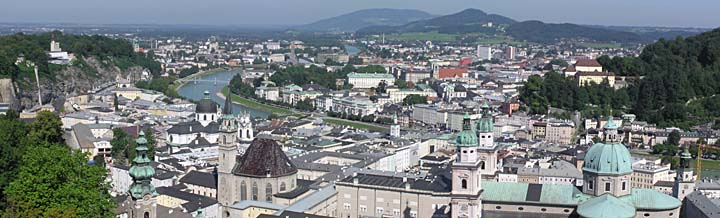
Salzburg, the home of Mozart and a beautiful city along the Salzach river near the border with Germany. We first visited here in 1997 with Verna’s folks, then returned again in 2004 on the motorbikes. Below is a panoramic view of the city, highlighting the many churches in the city in the foreground. The city is set in the flat valley between the mountains.
|
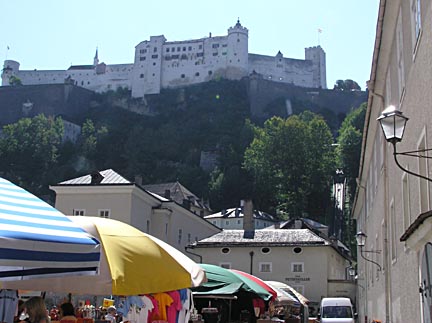
High above the city sits the fortress Hohensalzburg (photo below). A funicular can take you easily up the hill in a few minutes, or you can choose to climb the rather steep hill. (We chose to ride up and walk down.) Once at the top you get a sweeping view of the city from the many ramparts. The fortress itself is an interesting visit; begun in the late 1400’s, it has been added to over the years. An additional ticket will allow you to visit the interior rooms of the residence.
|
|
|
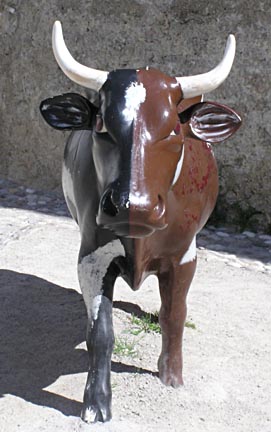
One of the interesting points is this half brown - half black ox in one of the courtyards. The story goes that sometime around 1525 the fortress was besieged by an enemy army. It lasted long enough that the residents were down to their last ox. Wanting to show their strength, they washed and painted their last ox black on one side, leaving the other side brown. They then paraded the ox along the ramparts, back and forth so the enemy could see they were not near starvation. The enemy was fooled, believing the citizens had enough food to last a very long time and gave up the siege. The residents washed the ox one last time and ever since then the people of Salzburg have been known as the “stierwaschers” or oxen-washers.
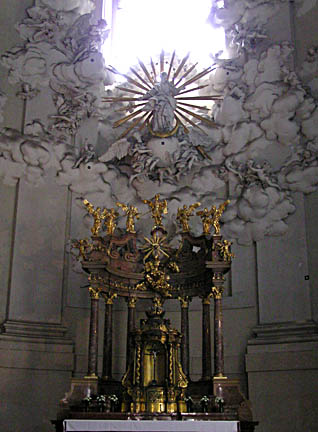 Later, the town of Salburg as we know it today was built up below the fortress, along the river. The older part of town is between the river and the fortress. Here we found the many churches of Salzburg, from the huge Dom (cathedral) to the smaller University church and Franziskanerkirche. Behind the altar of the University church is a rather unique wall decor (shown left). The wall is covered with clouds and cherubs, climbing up to heaven. In this area is also a monastery with catacombs as well as the Residenz. The plazas or squares between these buildings have been taken over by the vendors, selling their bretzels and other wares, as well as the street musicians and the occasional restaurant. We stumbled upon the university mensa (cafeteria) in a courtyard alongside the Franziskanerkirche. Here we got a soup, entree and salad for €3.80. What a deal! Later, the town of Salburg as we know it today was built up below the fortress, along the river. The older part of town is between the river and the fortress. Here we found the many churches of Salzburg, from the huge Dom (cathedral) to the smaller University church and Franziskanerkirche. Behind the altar of the University church is a rather unique wall decor (shown left). The wall is covered with clouds and cherubs, climbing up to heaven. In this area is also a monastery with catacombs as well as the Residenz. The plazas or squares between these buildings have been taken over by the vendors, selling their bretzels and other wares, as well as the street musicians and the occasional restaurant. We stumbled upon the university mensa (cafeteria) in a courtyard alongside the Franziskanerkirche. Here we got a soup, entree and salad for €3.80. What a deal!
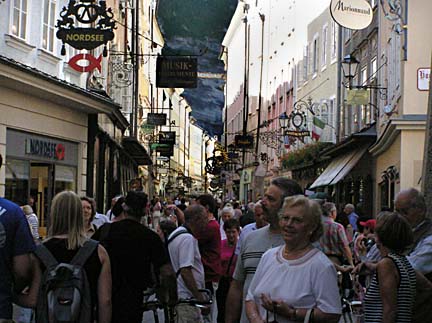 The merchant part of town grew up just outside the church area and is a maze of narrow streets lined with small shops and arched alleyways (right). Each shop has a sign coming out from the wall above, many of them in decorative wrought iron. As you can see, it was still full of tourists when we were there in early September. Lots of decorated linens, Christmas decorations, hats, clothing and of course, chocolate shops abound. The Mozart chocolate is featured almost everywhere, a decadent concoction of marzipan, hazelnuts and chocolate, wrapped in red and silver foil. Yum! The merchant part of town grew up just outside the church area and is a maze of narrow streets lined with small shops and arched alleyways (right). Each shop has a sign coming out from the wall above, many of them in decorative wrought iron. As you can see, it was still full of tourists when we were there in early September. Lots of decorated linens, Christmas decorations, hats, clothing and of course, chocolate shops abound. The Mozart chocolate is featured almost everywhere, a decadent concoction of marzipan, hazelnuts and chocolate, wrapped in red and silver foil. Yum!
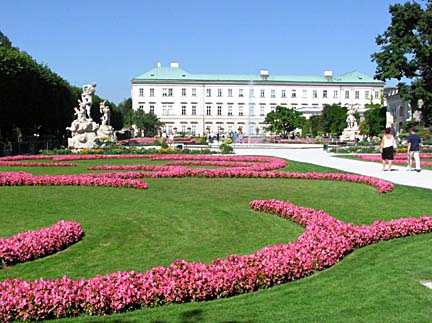 Across the river is the Schloss Mirabell and its surrounding gardens that make for a pleasant stroll (left). The bright pink begonias were in full bloom, providing a colorful view for the visitors. The palace is open for tours if you want to see how the rich people live. The palace was built by the prince-archbishop Wolf Dietrich for his mistress in 1606. The gardens were featured in “The Sound of Music.” Across the river is the Schloss Mirabell and its surrounding gardens that make for a pleasant stroll (left). The bright pink begonias were in full bloom, providing a colorful view for the visitors. The palace is open for tours if you want to see how the rich people live. The palace was built by the prince-archbishop Wolf Dietrich for his mistress in 1606. The gardens were featured in “The Sound of Music.”
|