|
 |
|
|
|
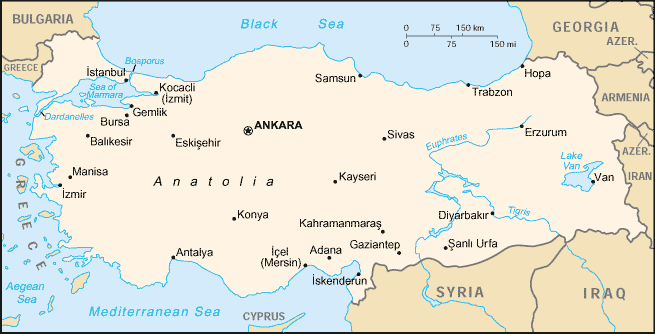
Is Turkey European or is it Asian? We have decided to put Turkey in the Asian section of our travels for physical reasons: 97% of the land mass lies on the Asian continent. Only a small portion (3%) lies on the European continent (contiguous with Bulgaria and Greece). But politically, Turkey may be closer to Europe than Asia, with a possibility that it may join the European Union.
Constantine became ruler in 324 and reunited the empire, building the city of New Rome, later renamed Constantinople as the capital of the Byzantine Empire. The first real Turkish state was created by the Seljuks from 1037-1109, but in 1243 the Mongols invaded, crushing the Seljuks. From a small Turcoman emirate, the great Ottoman Empire emerged and grew until it held land across southern Europe, the Middle East, and Northern Africa. Decline began with the defeat at Lepanto by the Venetians and Spaniards in 1571. By early 17th century, the Ottoman expansion had ended and by the 19th century strong currents of ethnic nationalism were flowing eastward from Europe. The people revolted. In 1832 the Kingdom of Greece was formed, and soon after the Serbians, Bulgarians, Romanians, Albanians, Armenians and Arabs all sought independence. The Ottomans sided with Germany in WWI, and after the war Turkey was parceled out to the Allies. Beginning in 1920, Turkish war of Independence resulted in the creation of the Turkish Republic. All of these civilizations left their marks on the landscape, in the architecture, and in Turkish society. Our belief is that to understand what you see in Turkey, you have to have some understanding and appreciation for the tumultuous history. As an example, although the population is 99% Muslim, it is surprising to find a large number of Christian churches (they were built during the Roman age). Today Turkey is a thriving country, one of only 7 countries in the world that is able to fully feed its people and still have extra to export. The economy is supported by a combination of modern industry and traditional agriculture. It is currently in negotiations with the European Union to join sometime in the future and appears to be making significant progress in that direction. |
|||
 |
|||
|
If you find typographical errors or have any other problems when looking at the site please contact the Webmaster describing the problem and the page involved. |
|||
|
Copyright © 2000-2009 Jim Seavey and Verna Norris All Rights Reserved |
|||