|
 |
|
||||||||||
|
Tangier is probably the most oft-visited Moroccan city, probably because of its previous international status. As such, it is not uncommon to see busloads of tourists oohing and aahing at the sites. Because of the language and cultural differences, most people coming to Tangier take advantage of one of the many tours organized from Spain or Gibraltar. These tours are normally one day and include the round-trip ferry ride, lunch, and a guided tour. Of course, as part of the guided tour, there are the usual stops at the brother-in-law’s rug mart or the uncle’s spice market. While the usual high-pressure tactics are used once in these shops, there is also some good information exchanged and you can use it to practice your assertiveness. We have been to Tangier twice so far, both via the one-day tour. The first time we took the trip from Gibraltar (December, 2000) and opted for the tour offered at the ferry office. This tour took the fast ferry that went directly to Tangier - it left at about 9am, took 1 1/2 hours to cross, we had about 4 hours in Tangier, then returned on the afternoon ferry, getting in Gibraltar about 6:30. The second time (February 2001) we took a tour from Spain, leaving our hotel by bus at 7, catching the ferry in Algeciras at about 9, taking about 45 minutes to cross, landing in Ceuta (pronounced soota), then bussed overland to Tangier (about 1 1/2 hours). Again we had about 4 hours in Tangier before being bussed back to Ceuta, crossed the straights, arriving in Algeciras about 8 pm and our hotel by 9. While the second trip made for a very long day, we felt the ferry ride was shorter and better, and we had a better view of Morocco other than just Tangier.
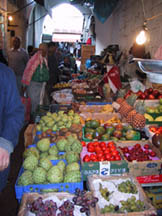
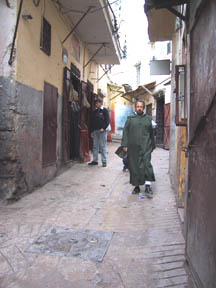
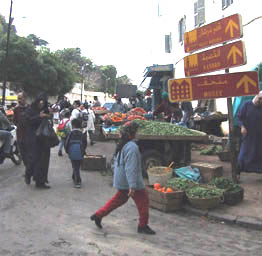
After lunch, we drove through the old American, French and Spanish portions of Tangier, a reminder of the time when Tangier had been an international zone, controlled collectively by nine different countries from 1923 to 1957 ( in order to assure control of the Straits). Then on to the Medina (left), the oldest part of Tangier and the Casbah, which was the fortress section that guarded the city. The buildings so crowd in that you can see dayligh Interspersed with the homes are small shops dotting the neighborhood, usually nothing more than a single room, crammed full of whatever is being sold. One interesting sight is the local bakery - a single dark room containing an oven and a few shelves for the bread to rise. You can’t buy bread there, as it is where the local women bring their dough to rise and bake. This is an area you probably don’t want to be alone in; not because of safety, but because the chances of getting hopelessly lost are very great. Wandering out of the medina we find ourselves in the general market area - carts of fresh fruits and vegetables (left) lining the streets and potential buyers everywhere. There is also an indoor market nearby, full of stalls of any kind of food needed for the local population. And all the fresh food here is raised or grown locally - fruits and vegetables (below left), olives galore (below right), chickens, eggs, spices, and dried legumes and grains.
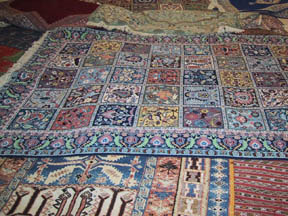 shows a large rug, explaining how it can be reversed for summer use - 2 sides for the price of one! Then his helpers come out and bombard you with a vast array of different designs and sizes, rolling each one out with a snap. By now the floor is practically covered with carpets and they invite you to walk upon them and choose one you like. Here’s where the hard sell really begins. One of the helpers selects a couple or small group of tourists - and doesn’t let go until you walk out the door! But don’t be put off by this. Enjoy yourself, ask questions, use it as a learning experience. Just keep saying “no.” Verna’s favorite was the 4 Seasons rug (right), but felt it was too big for the tent. shows a large rug, explaining how it can be reversed for summer use - 2 sides for the price of one! Then his helpers come out and bombard you with a vast array of different designs and sizes, rolling each one out with a snap. By now the floor is practically covered with carpets and they invite you to walk upon them and choose one you like. Here’s where the hard sell really begins. One of the helpers selects a couple or small group of tourists - and doesn’t let go until you walk out the door! But don’t be put off by this. Enjoy yourself, ask questions, use it as a learning experience. Just keep saying “no.” Verna’s favorite was the 4 Seasons rug (right), but felt it was too big for the tent.
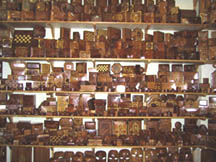
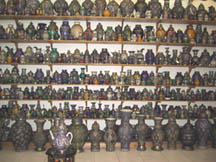
These shops almost always have the rugs on the 3rd floor. When you have enough of the rugs, you head down the stairs to the next level which is usually filled with leather goods and clothing. And your helper follows you! If you keep going to the bottom floor, there you will find the pottery (below right), and carved or inlaid wood items (below left). There are usually some very nice items for your own use or gifts, so shop around. Once you move toward the exit door, your helper will head back upstairs.
Back out on the street, you will be accosted by the street vendors. They have bracelets, stuffed camels, jalabas, you name it. They will stick them in your face, they will step in front of you, anything to make you buy. If you pay attention at all, they will keep selling. Simply ignore them and they will go find a more receptive customer. |
||||||||||||
 |
||||||||||||
|
If you find typographical errors or have any other problems when looking at the site please contact the Webmaster describing the problem and the page involved. |
||||||||||||
|
Copyright © 2000-2009 Jim Seavey and Verna Norris All Rights Reserved |
||||||||||||
 The meals we had each started with a tasty vegetable soup, followed by a meat dish, usually lamb or beef kebabs and a cous cous dish with vegetables and some chicken. A light pastry dessert is usually served and of course the sweet mint tea. While the meals are included in the tours, any drinks are always extra. Some type of entertainment is usually provided (music and/or dancing) and of course, diners are expected to tip the entertainers (pesetas are accepted).
 t only by looking straight up. The design for this fortress portion of the city was to assure that any invaders must enter singly, thus being perfect targets for entrapment. The Casbah is actually divided into sections (none of which was visible to us, but seemingly like neighborhoods), with each section having its four vital services: a preschool at which the young children learn the Koran, a bakery, a steam bath for weekly cleansing, and a mosque.