 |
 |
|
||||||||
|
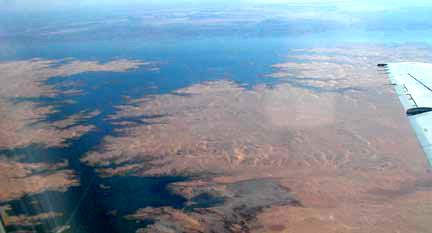
Abu Simbel is located about 40 km north of the Sudanese border and was our most southern visit in Egypt in January 2002. We had chosen to fly there from Aswan when we first made our reservations in Spain, not realizing that you could also take a bus for a little more than half the cost. However, to take the bus, the participants had to rise at 3:30 a.m. and leave by 4 am. We got to sleep until 6:30, have a leisurely breakfast, then head to the airport for an 8:30 flight. Of course it didn’t leave until 9:30. And don’t believe the flight status boards as they reported the flight departed at 8:30.
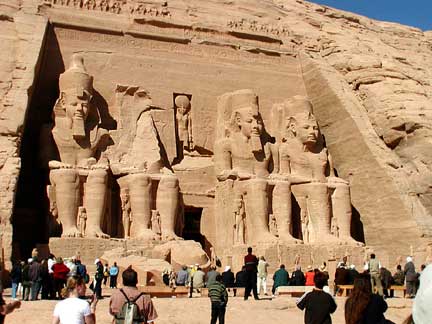
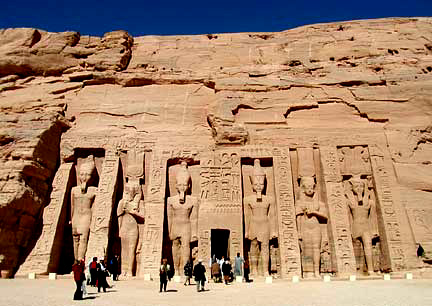
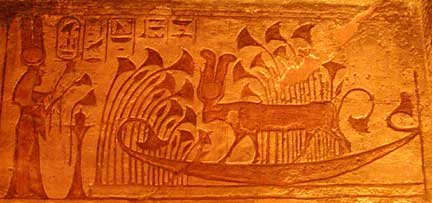
The sight is a short bus ride from the airport and a brief walk from there. Our guide described everything outside before we entered so we don’t have to fight tour groups once inside. And, there were not that many people at the site when we were there - about 100. The immensity of the statues (below) and the quality of the carvings inside are impressive enough, until you realize that these two temples were moved some 200 meters from their original sites when the new Aswan high dam was built. As the waters were risin The temples were built by Ramses II during the 12th century BC. The larger is the Sun Temple (above) faced by 4 gigantic (20 meter high) enthroned colossi of Ramses hewn from the mountain side. The legs were somewhat crudely carved, but the torsos and heads are finely carved. Lots of graffiti from the 1800s adorns the lower legs. The temple was precisely oriented so that the sun’s rays reached deep into the mountain to illuminate its sanctuary on his birthday and the anniversary of his coronation. Inside the Sun temple, giant (10 meters high) statues of Ramses line the central corridor of the Hypostyle Hall (left). The walls and ceilings are all exquisitely adorned and there are several side chambers that were probably used to store cult objects. At the back is the central sanctuary where the sun’s rays at dawn would have shown on the cult statues on February 21 (Ramses birthday) and October 21 (his coronation). The move resulted in the dates now being February 22 and October 22. The smaller queen’s temple was in honor of his queen, Nefertari. Although smaller, it is equally impressive both in the exterior carvings (below right) and the interior decoration. The exterior carvings are of Ramses and Nefertari with smaller statues of their children near their lower legs.
For more photos of Abu Simbel, click here. |
||||||||||
 |
||||||||||
|
If you find typographical errors or have any other problems when looking at the site please contact the Webmaster describing the problem and the page involved. |
||||||||||
|
Copyright © 2000-2009 Jim Seavey and Verna Norris All Rights Reserved |
||||||||||
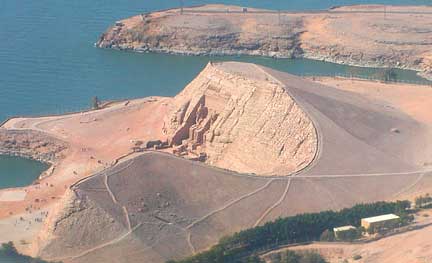
 g, workers were building a coffer dam around the sites to protect them while they moved everything. Because of the soft sandstone, hand saws were used on all visible surfaces to a depth of about 2 meters. The entire site was moved, block by block and reconstructed on the new site, in the same orientation as the original site. This endeavor took 8 years and used some 30 tons of reinforcing steel and 23 tons of epoxy resin to seal the seams and reinforce cracks. You can clearly see the seams in the blocks that were used to create the mountain facade, but they ar
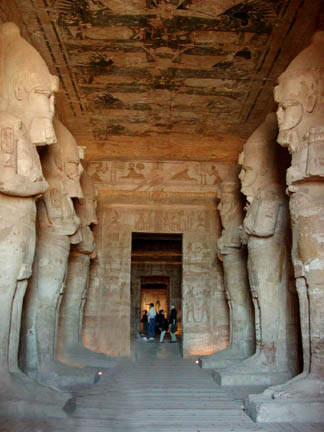 e barely visible in the statues and interior rooms. What a feat! And thanks to UNESCO for initiating it was well as Austria, Belgium, Spain and the US for helping to finance the operation ($40 million).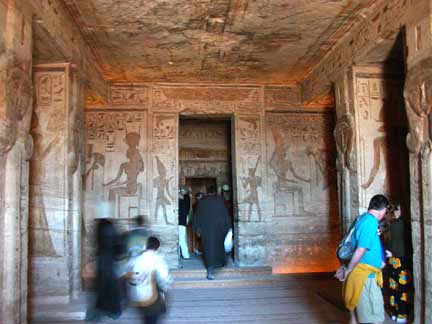
 We had plenty of time to see everything and take lots of pictures, but he same cannot be said for those who took the bus. They traveled in a convoy of 36 busses - for protection (their are police checkpoints at either end) and also for safety. There is nothing but desert for 4 1/2 hours. If a bus were to break down, the others could help transport the passengers. Then, every bus arrives at the site at the same time. This meant that there were more than 1300 people who arrived at the same time. From the reports we heard, you couldn’t easily see everything and quality photos were next to impossible. If you take this journey, we suggest taking the plane and not the bus for this portion of the journey.